
Browse Articles Online
Case Report | Open Access
Published on: 19 Feb 2026
Article ID: wjcds.2026.b1902
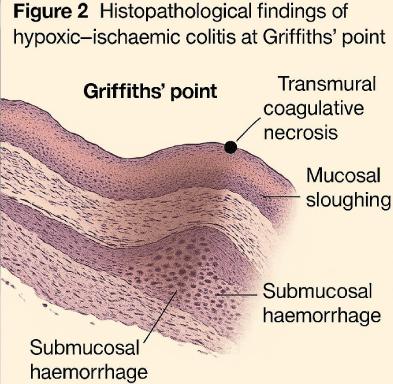
Hypoxic-Ischemic Colitis at Griffiths’ Point in a Term Infant with Hypoxic-Ischemic Encephalopathy and Acute Kidney Injury Requiring Emergency Subtotal Colectomy
A term male neonate with moderate Hypoxic-Ischaemic Encephalopathy (HIE) developed persistent rectal bleeding and rising inflammatory markers during therapeutic hypothermia. Despite conservative management, he deteriorated with signs of colonic ischaemia. Imaging suggested segmental hypoperfusion centred at Griffiths’ point at the splenic flexure, a recognised colonic watershed zone. Emergency laparotomy revealed extensive non-viable colon requiring subtotal colectomy with end ileostomy.…



Letter to Editor | Open Access
Published on: 19 Feb 2026
Article ID: wjd.2026.b1903
Sleep Disturbance and Mental Health Burden of Prurigo Nodularis in Older Adults: Implications for Cognitive Decline and Delirium Risk
Background: Prurigo nodularis (PN) is a chronic inflammatory dermatosis characterized by severe pruritus and nodular skin lesions and disproportionately affects older adults. Although PN is traditionally conceptualized as a dermatologic condition, its associated sleep disturbance and psychological burden may be particularly relevant in geriatric populations.
Objective: This review synthesizes existing evidence describing sleep disturbance,…

Case Report | Open Access
Published on: 19 Feb 2026
Article ID: wjh.2026.b1904
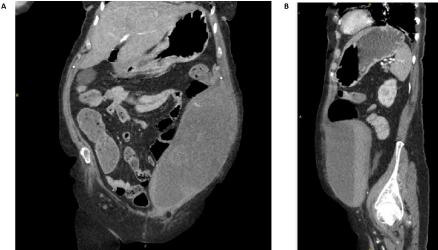
Giant Spontaneous Inferior Epigastric Artery Rectus Sheath Hematoma
A spontaneous inferior epigastric artery rectus sheath hematoma is a rare condition where bleeding occurs within the sheath of the rectus abdominis muscle, often due to damage to the inferior epigastric artery or its branches. We present an adult case of giant spontaneous left inferior epigastric artery rectus sheath hematoma with dramatic life-threatening acute abdominal emergency which was managed successfully by conservative management.
Keywords: Acute Abdomen;…

Review Article | Open Access
Published on: 19 Feb 2026
Article ID: wjwh.2026.b1905
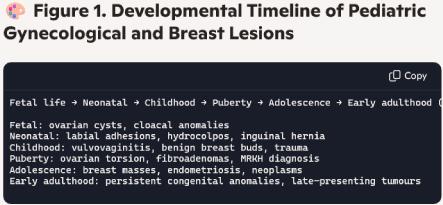
Pediatric Gynecological and Breast Surgical Lesions from Fetal Life to Early Adulthood: A Comprehensive Review
Objectives: To synthesise current evidence on congenital, developmental, infectious, neoplastic, and traumatic gynecological and breast lesions requiring surgical evaluation or intervention in girls from fetal life to 21 years, highlighting diagnostic pathways, operative indications, outcomes, and gaps in knowledge.
Design: Narrative review of published literature, clinical guidelines, and surgical series across pediatric gynecology, pediatric…

Case Report | Open Access
Published on: 19 Feb 2026
Article ID: wjnp.2026.b1906
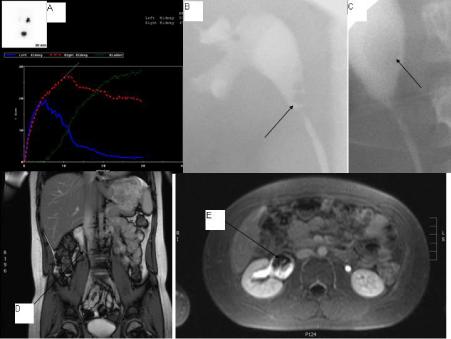
Ureteric Fibroepithelial Polyp in a Child-Recurrent Presentations and Diagnostic Dilemma
Benign ureteral polyps, also known as fibroepithelial polyps, can cause upper urinary tract obstruction by growing to block the flow of urine from the kidney. Fibroepithelial polyps are very rare benign lesions originating from the mesoderm. We have presented an interesting and unusual case who presented with recurrent right sided abdominal colicky pain and vomiting. During investigation was found an underlying cause of right sided abdominal intermittent pain at the right pelviureteric…

Case Report | Open Access
Published on: 19 Feb 2026
Article ID: wjim.2026.b1907
Motility Disorder, Meckel’s Diverticulum and Mass in a Toddler Girl-Mere Coincidence or Causation Link
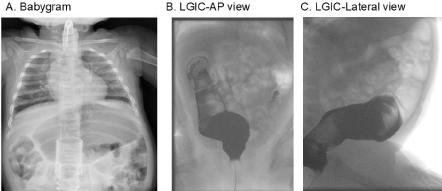
We present unique and an interesting case of a toddler girl who had all three in one lesion with a known case of hypoganglionosis. Patient presented with recurrent right sided abdominal colicky pain, vomiting and a right lower abdominal mass. During abdominal ultrasound, an ileoileal intussusception was found. Patient underwent minimal invasive approach using laparoscopy at which the ileoileal intussusception was reduced and an inverted Meckel’s diverticulum with ectopic mucosal nodule was…

Case Report | Open Access
Published on: 19 Feb 2026
Article ID: wjms.2026.b1908
Recurrent Perineal Abscesses Arising from a Congenital Isolated Perineal Canal Mimicking Crohn’s Disease: A 22‑Year Diagnostic Odyssey
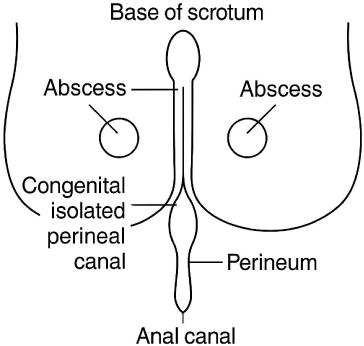
A 40‑year‑old man presented with recurrent perineal abscesses originating from a congenital isolated perineal canal extending from the anterior aspect of the anal canal to the base of the scrotum. Since the age of 18, he experienced 3‑4 episodes of painful perineal swelling requiring incision and drainage. The chronicity and midline perineal involvement raised repeated concerns for underlying Crohn’s disease. However, serial MRI pelvis studies, colonoscopic evaluations, and histology from…


Case Report | Open Access
Published on: 14 Feb 2026
Article ID: wjptr.2026.b1401
Fascia-Oriented Clinical Pilates in Myalgic Encephalomyelitis/Chronic Fatigue Syndrome with Multisystem Post-Vaccination Sequelae: A Retrospective Case Report
Myalgic Encephalomyelitis/Chronic Fatigue Syndrome (ME/CFS) is a complex, chronic, multisystem disorder characterized by persistent fatigue, post-exertional malaise, autonomic dysfunction, neuromuscular impairment, and cognitive disturbances. Standard rehabilitation approaches are often poorly tolerated due to symptom exacerbation, highlighting the need for safe, individualized, low-load interventions. Clinical Pilates (CP), emphasizing controlled movement, core stabilization, alignment, and…

Research Article | Open Access
Published on: 14 Feb 2026
Article ID: wjptr.2026.b1402
Neuromuscular Adaptations of the Rotator Cuff and Scapular Stabilizers Following TheraBand-Based Throwing Training in Symptomatic Volleyball Players with Shoulder Internal Rotation Deficit: A Randomized Controlled Trial
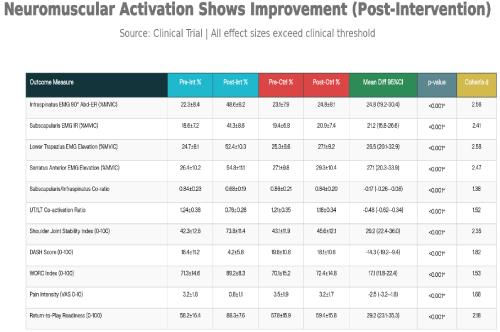
Background: Glenohumeral internal rotation deficit (GIRD) rehabilitation literature lacks comprehensive neuromuscular analysis explaining motor control mechanisms underlying elastic resistance training effectiveness. Current evidence emphasizes range of motion and pain outcomes without addressing rotator cuff and scapular stabilizer activation patterns or co-contraction dynamics essential to shoulder stability.
Objective: This randomized…

Research Article | Open Access
Published on: 14 Feb 2026
Article ID: wjptr.2026.b1403
Effectiveness of Theraband-Based Throwing Exercise in Volleyball Players with Symptomatic Glenohumeral Internal Rotation Deficit: A Randomized Control Trial
Background: Glenohumeral internal rotation deficit (GIRD) is prevalent in overhead athletes, particularly volleyball players, contributing to shoulder pain and functional limitation during throwing activities. Theraband-based throwing exercises have demonstrated potential for rotator cuff retraining, yet their efficacy in symptomatic athletes requires rigorous evaluation.
Objectives: This randomized controlled trial evaluated the effectiveness of…